
Goat Chinese Zodiac Personality
The Sign That Feels Everything and Shows Only Some of It
The Goat feels the world more completely than most people ever will. The work is learning that this is not a burden to be managed — it’s a capacity worth protecting.
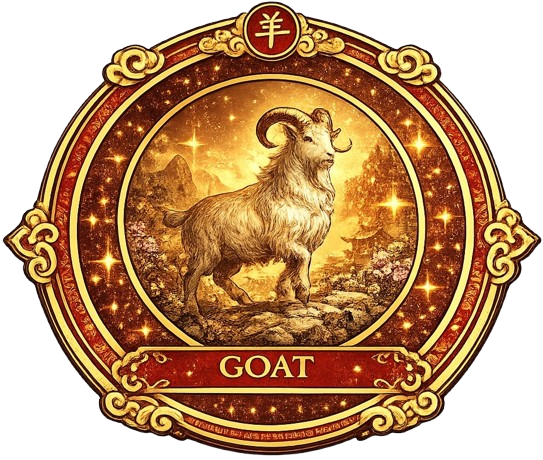
Yin Energy · Fixed Element: Earth
Goat years: 1931, 1943, 1955, 1967, 1979, 1991, 2003, 2015, 2027. The next Goat year begins in 2039.
At A Glance
Core Trait
Feels the emotional atmosphere of a room before anyone names it
Biggest Strength
Depth of feeling, genuine compassion, creative sensitivity
Biggest Weakness
Sensitivity collapsing into helplessness when support feels absent
In Relationship
Devoted and tender; needs steadiness more than grand gestures
At Work
Thrives where creativity and human connection are valued; wilts in cold systems
Under Stress
Retreats inward; resists through passivity; waits to be reached
The Goat doesn’t need the world to be simple. It needs the world to be kind — and when it isn’t, it feels that more acutely than almost anyone.
There’s a person who can tell, the moment they walk into a room, whether the energy is off. Not from anything said — from something felt. The slight tension that hasn’t surfaced yet. The mood underneath the politeness. They can feel it the way other people feel temperature.
That’s the Goat Chinese zodiac personality. And most of the time, they don’t say what they noticed. They just quietly adjust to it, carry it, and hope someone eventually makes the room feel safer.
That’s the Rat Chinese zodiac personality at its most recognizable. And if it sounds like someone you know immediately, that’s not a coincidence.
The Goat is the eighth sign in the Chinese zodiac — emotionally deep, creatively alive, and more affected by the atmosphere around them than almost any other sign in the system. This isn’t fragility, though it can look like it. It’s a form of perception that most people don’t have and can’t fully imagine — the world arriving in emotional color rather than neutral information, every interaction carrying a texture that lingers.
Understanding the Goat zodiac personality means understanding what it actually costs to live that way, and what it produces when the conditions are right.
How Goat Feels the World
The Goat doesn’t analyze a situation first. They feel it. The emotional temperature of a conversation, the quality of attention someone is giving, whether a space feels welcoming or subtly hostile — all of this arrives before the rational layer has a chance to process it. And it doesn’t leave quickly.
Most signs absorb an experience and move on. For Goats, the experience stays — not as a memory exactly, but as a residue, a feeling that lingers past the moment and influences what comes after. A harsh comment in a meeting in the morning can still be present at dinner. A moment of unexpected kindness can open something up that carries through an entire day. The emotional world is not background noise for this sign. It’s the primary channel.
This gives Goats a particular gift in human situations. They notice what people need before it’s stated. They sense distress that’s being hidden, joy that’s being understated, loneliness wearing the clothes of fine. The compassion that follows from this is genuine — not performed empathy but actual response to what has actually been felt.
Sensitive does not mean fragile. The Goat feels more than most — and carries more than anyone sees.
What it costs is real. Environments that are cold, competitive, or emotionally careless take a toll on Goats that goes beyond normal fatigue. They can’t simply decide not to be affected by the atmosphere they’re in. They are affected. The question is always whether the environment is one that sustains them or one that slowly empties them — and Goats often stay in the second kind longer than they should, hoping it will improve, absorbing the damage quietly.
The Way Goat Makes Decisions
Goats decide through feeling, but it’s a feeling that runs deep and takes time. They’re not impulsive — the emotional processing is thorough even when it’s not visible. Before a Goat commits to something, they’ve been living inside the question for a while, turning it over in the way you turn over something you care about getting right.
Safety matters more than speed. A Goat who doesn’t feel secure in a situation — who doesn’t trust that the environment will support what they’re trying to do — will hesitate past the point that looks reasonable from outside. Not because they lack the capability, but because capability without emotional footing doesn’t feel like a reliable place to stand. The hesitation is real information, even if it reads as indecision.
Their values are strong and not easily argued out of. Goats can seem accommodating — and they often are, in the smaller negotiations of daily life — but on the things that actually matter to them, there’s a quiet firmness that surprises people who assumed the softness went all the way through. They won’t announce that they’ve decided. They’ll just not move, and no amount of pressure will change that once the position is actually set.
If you’ve ever found yourself unable to do something you were fully capable of doing, purely because the environment or the relationship surrounding it felt wrong — not logically wrong, just wrong — you understand how the Goat’s emotional reasoning works in practice.
What Happens Under Pressure
When the pressure gets too heavy — when the emotional environment turns harsh, or when demands pile up past what feels manageable — the Goat retreats. Not dramatically. Quietly. The external compliance may stay in place for a while; the Goat keeps showing up, keeps doing what’s expected, but something inside has pulled back and is no longer really there.
The resistance under pressure tends to be passive rather than direct. Goats don’t typically confront what’s overwhelming them — they absorb it until absorption stops working, and then they begin to slow down. Miss things. Forget things. Become unavailable in ways they can’t fully explain because the unavailability is emotional rather than logistical.
The Goat under pressure doesn’t fight back. It goes somewhere inside where the pressure can’t reach — and waits.
Criticism lands harder than intended, and stays longer than it should. A single sharp comment from someone the Goat respects can undo a week of good momentum. This isn’t weakness — it’s the same sensitivity that makes them perceptive applied in the direction of pain. The signal that something is wrong is received at the same volume as the signal that something is beautiful. Goats don’t get to choose which register to turn down.
What they need under pressure — and often don’t ask for clearly, because asking directly feels like admitting something they’ve been told shouldn’t be a vulnerability — is steadiness from the people around them. Not solutions. Not redirection. Just the sense that they are safe, that the environment holds, that they don’t have to manage alone.
How Goat Handles Relationships
Goats love with real devotion. When they’re committed to someone, the care runs deep — in the attention they pay, the way they remember what matters to you, the genuine effort they put into making the relationship feel warm and considered. They don’t love casually. When they’re in, they’re genuinely, completely in.
What they need in return is steadiness. Not perfection, not intensity — steadiness. The reassurance that comes from consistent behavior, from someone who shows up the same way on the hard days as the easy ones. A Goat who feels secure in a relationship flowers in a way that’s unmistakable. A Goat who doesn’t feel secure contracts, and the contraction is difficult to reverse once it’s begun.
“A Goat in a good relationship becomes more fully themselves — more creative, more open, more willing to take the risks that their sensitivity usually makes feel too costly. The relationship doesn’t just support them. It makes them possible.”
The difficulty is asking for what they need. Goats feel their needs acutely — the need for reassurance, for gentleness, for the particular emotional safety that lets them open without fear. But translating those needs into direct requests feels exposing in a way that’s hard to explain. It’s easier to hope the other person notices. It’s easier to give generously and trust that generosity will be returned. It usually isn’t, not consistently, and the quiet disappointment that accumulates is one of the Goat’s most characteristic private experiences.
This pattern becomes most visible in Goat compatibility with signs that are emotionally direct and confident — signs that need explicit communication to know what’s actually needed, and that can’t always read the softer signals the Goat sends instead of saying the thing plainly.
Money, Work, and Creative Stability
Goats work best where the environment is human. Where beauty is considered, where relationships matter, where the quality of how something is done is as valued as whether it gets done. They bring real gifts to these environments — sensitivity to what’s missing, an aesthetic sensibility that lifts the work, an emotional intelligence that makes collaboration feel like something worth having.
Put a Goat in a system that runs on pure efficiency, that treats people as variables, that has no room for the slower, more considered approach that emotional depth sometimes requires — and something essential in them goes offline. The work continues. The Goat does what’s asked. But the distinctive quality disappears because it only appears when the conditions allow it.
Money carries a specific kind of anxiety for many Goats — not greed, but the deep discomfort of instability. Material security is emotional security for this sign in a way that’s more direct than for most. When finances feel uncertain, everything else feels uncertain too, and the creative life that usually sustains them becomes harder to access. The Goat’s relationship with financial security is worth taking seriously as a psychological need rather than a practical detail.
In the right environment — one that respects what they bring, that gives them enough structure to feel held and enough space to actually create — Goats produce work of genuine beauty and emotional resonance. The conditions matter as much as the capability. Removing the conditions doesn’t reveal what the Goat can really do. It removes it.
The Five Elements of the Goat
The Goat’s emotional sensitivity and need for a supportive environment persist across all birth years. The element shapes how that sensitivity is held — how much it opens outward, how much it turns inward, and how the Goat manages the gap between what they feel and what they can express.
木
Wood Goat · 1955, 2015
The most social and outward-facing variation. The sensitivity is still there but more directed toward others — toward community, connection, and making things better for the people around them. More willing to advocate for what they feel, and more able to translate feeling into action.
火
Fire Goat · 1907, 1967
More expressive and emotionally visible than the other variations. The feeling runs hotter and closer to the surface. More charismatic, more likely to take creative risks, more affected by the emotional weather around them in both directions — joy amplified, hurt amplified equally.
土
Earth Goat · 1919, 1979
The most stable and self-sufficient of the five. Practical enough to function well without ideal conditions, more able to hold their own emotional weight. Still sensitive — still deeply feeling — but with more internal grounding that prevents the sensitivity from becoming overwhelm as quickly.
金
Metal Goat · 1931, 1991
More principled and private than other variations. The soft exterior holds a firmer interior here — clearer standards, more willingness to hold a boundary even when it’s uncomfortable. The feeling is still present but managed with more discipline and less visibility.
水
Water Goat · 1943, 2003
The most emotionally permeable and imaginative of the five. The sensitivity goes deepest here — to the point where the Goat can feel genuinely unclear about where their own emotional experience ends and others’ begins. Most creative, most empathetic, and most in need of environments that actively protect their emotional space rather than leaving them to manage it alone.
When Goat Meets Western Astrology
The Goat layer adds emotional depth, aesthetic sensitivity, and a need for supportive conditions to whatever Western sign it lands on. The effect is a softening and an deepening — the sign’s drives become more feeling-oriented, its expression more attuned to beauty and human texture, and its performance more dependent on the emotional environment it’s operating in.
An Aries Goat still has the boldness and initiative — but it’s more emotionally considered, more affected by how the bold move lands with the people involved, and more reluctant to push into territory that feels emotionally unsafe. A Capricorn Goat carries real ambition and real discipline, but underneath the competence there’s a sensitivity that the typical Capricorn presentation doesn’t usually show — a need for the work to feel meaningful, not just successful. A Gemini Goat is curious and communicative, but the Goat’s emotional depth pulls the typically surface-level Gemini processing into something considerably more interior and considered.
The combination that tends to produce the most emotionally profound — and most easily overwhelmed — personality is Water Goat paired with Pisces. Two systems of feeling stacked together, both deeply permeable to the emotional environment, both in need of considerable conscious attention to their own boundaries. Extraordinarily empathetic. Extraordinarily susceptible to absorbing what surrounds them.
The Real Growth Edge
Sensitivity is not the problem. That needs to be said clearly, because Goats have often absorbed the message — from school, from workplaces, from people who didn’t know what to do with that much feeling — that their sensitivity is something to manage, minimize, or apologize for. It isn’t. It’s the source of everything valuable about them.
The growth edge is what happens when sensitivity isn’t accompanied by boundaries — when the feeling goes in and nothing goes out to regulate it. When the Goat absorbs the emotional environment fully but doesn’t have a structure for what to do with what they’ve absorbed. The sensitivity becomes overwhelm. The depth becomes a place they disappear into. The care for others becomes a substitute for asking for care themselves.
Boundaries don’t harden sensitivity. They protect it. A Goat who has learned to say — clearly, without apology — what they need from an environment, a relationship, a situation, is not a less sensitive Goat. They’re a Goat whose sensitivity is available for the things that deserve it rather than being consumed by the things that don’t.
This also means learning to ask for what they need directly. Not hoping someone will notice, not giving generously and trusting it will come back — actually naming it. The fear underneath is that the asking will reveal a need so large it will overwhelm the other person, or confirm some private worry that what they need is too much. Usually, it isn’t. Usually, the people who love a Goat were waiting to be told what would help, because the signals were too quiet to read with confidence.
The Goat Chinese zodiac personality has always been capable of extraordinary things — in relationships, in creative work, in the human texture of every environment they enter. The growth edge is simply learning that the sensitivity that makes all of that possible doesn’t have to be carried alone.
Frequently asked questions
Being a Rat represents intelligence, strategy, and adaptability. Rats are known for their sharp observation skills and ability to quickly analyze situations, often appearing intuitive but actually relying on rapid mental processing.
Rats excel in observation, flexibility, subtle communication, and resourcefulness. They notice details others miss, adapt quickly to change, and find solutions even in limited circumstances.
Rats can struggle with overthinking, mild paranoia, and a need for control. Their strong analytical mind may lead them to see patterns or signals that don’t actually exist, especially under stress.
Rats are cautious and observant before committing, but once they do, they are loyal and attentive partners. They value stability and clarity, and prefer partners who are direct, patient, and consistent.
Rats thrive in fields that require strategy and observation, such as writing, law, finance, investigations, and consulting. They perform best in environments where they have autonomy and can use their intellect effectively.