
Monkey Chinese Zodiac Personality
The Sign Whose Mind Is Already Three Steps Ahead
The Monkey can figure almost anything out quickly. What takes longer to figure out is which things are worth figuring out slowly.
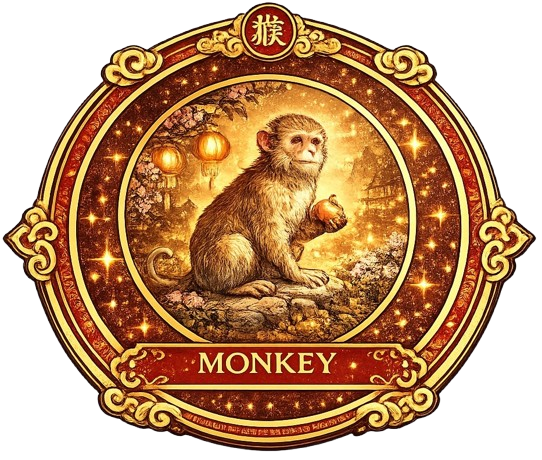
Yang Energy · Fixed Element: Metal
Monkey years: 1932, 1944, 1956, 1968, 1980, 1992, 2004, 2016, 2028. The next Monkey year begins in 2040.
At A Glance
Core Trait
Mind moving faster than the room; reads situations before others have framed them
Biggest Strength
Solves problems fast, improvises brilliantly, adapts to almost anything
Biggest Weakness
Speed without depth; starts strong and fades when novelty does
In Relationship
Charming and fun; uses wit where vulnerability might serve better
At Work
Brilliant at the early stage; restless once the challenge becomes routine
Under Stress
Deflects, pivots, overstimulates — keeps moving to avoid sitting with it
The Monkey can figure almost anything out. The question is whether they stay long enough to actually finish it.
There’s a person who has already solved the problem before the meeting is officially about the problem. Who makes a joke that is also, on closer inspection, the most accurate observation in the room. Who seems to be paying half-attention and retains everything.
That’s the Monkey Chinese zodiac personality. And the mental speed is real — not performance, not charm deployed strategically. Just how the brain works, constantly, at that frequency.
The Monkey is the ninth sign in the Chinese zodiac and one of the most immediately engaging — quick-thinking, socially agile, and constitutionally unable to be boring for very long. The intelligence is genuine and it moves fast. The humor that follows it isn’t decoration; it’s how Monkeys process reality, compress insight, and stay ahead of a situation without having to be visibly serious about any of it.
What’s harder to see from outside — and what makes the Monkey zodiac personality genuinely interesting — is what the speed costs them when they never slow down long enough to find out.
How Monkey Stays Three Steps Ahead
Monkeys don’t process situations the way most people do — linearly, step by step, waiting for enough information before forming a view. They scan the whole thing at once, pull the relevant parts, run a quick pattern-match against everything they already know, and arrive at a working theory while everyone else is still getting oriented.
This is not exaggeration. It’s a genuine difference in how the information gets handled. A Monkey in a new environment has usually mapped the social landscape — who’s actually running things, what the real dynamic is between the people involved, which conversations are worth having — before they’ve done anything that looks like deliberate assessment. It just happens. It happens fast.
The humor is part of the intelligence, not separate from it. A joke that lands with precision tells you exactly what the Monkey has noticed and what they think about it, wrapped in something that doesn’t require the room to be uncomfortable. This is clever in the most literal sense — it’s information delivery with a mechanism that bypasses resistance. Most people laugh before they’ve registered what was just said.
The Monkey isn’t being funny instead of being smart. The funny is the smart.
Where this gets complicated is in situations that require patience, sustained focus, or tolerating a pace that feels slower than necessary. Monkeys experience the gap between where something is and where it should obviously be as a kind of friction that’s hard to just sit with. They’d rather solve it, skip past it, or find a more interesting problem to work on in the meantime.
The Way Monkey Makes Decisions
Monkeys decide by improvisation — not randomly, but responsively. They take in the current conditions, spot the angle that others haven’t considered, and move. The plan gets built as they go. This produces genuinely creative outcomes in situations that reward flexibility, because the Monkey isn’t locked into a pre-committed approach and can adjust in real time as the situation develops.
The shortcut instinct is real and often valid. Monkeys are good at finding the faster route, the workaround, the solution that gets to the result without the unnecessary intermediate steps. Not laziness — pattern recognition that’s efficient enough to see that some of the steps aren’t actually needed. Frequently they’re right about this. Occasionally they skip something that mattered.
Consistency in decision-making is a different story. The Monkey who was completely committed to a direction last month and has since pivoted twice isn’t being flaky — they’ve genuinely updated based on new information, and in their experience that’s how intelligent decisions get made. The frustration of the people around them who needed something stable to plan around is real and also somewhat invisible to the Monkey, because from inside the mind, the logic of each pivot is entirely coherent.
If you’ve ever watched yourself move from enthusiastic launch to mild disinterest on something that was genuinely a good idea — not because it stopped being a good idea but because it stopped being a new one — you know the Monkey’s relationship with follow-through from the inside.
What Happens Under Pressure
Monkeys under pressure get busy. Not necessarily with the thing causing the pressure — with other things, faster things, things that provide the stimulation of forward movement without requiring them to sit inside what’s actually difficult. The mental engine speeds up. The humor comes out. The conversation gets redirected before it was finished.
Humor is the most characteristic defense mechanism here, and it’s a sophisticated one. A well-timed joke defuses tension, reframes the situation, and moves everyone along — and the Monkey genuinely believes that this is helpful, because most of the time it actually is. The problem is the category of situations where what’s needed isn’t defusing but sitting with. Where the joke isn’t moving toward a solution, it’s moving away from a feeling that the Monkey isn’t sure what to do with.
When the Monkey goes funnier under pressure, something harder is being avoided.
Overstimulation is real too. A Monkey who has been moving at high speed for too long — too many inputs, too many open loops, too many situations demanding the kind of fast response that depletes something — hits a wall that looks, from the outside, like distraction or disengagement, and is actually something closer to cognitive exhaustion that the Monkey doesn’t always recognize in themselves because the speed has felt normal for so long.
How Monkey Handles Relationships
Monkeys are genuinely enjoyable to be around — quick, funny, interested, able to make almost any situation feel lighter. The charm isn’t calculated. The engagement is real. When a Monkey is interested in you, the attention is focused and the conversation is alive in a way that’s memorable. This is attractive in a specific way: you feel seen, entertained, and like the person across from you is actually present rather than going through motions.
The complication is emotional consistency. Monkeys connect quickly and easily, which means the early stages of a relationship are usually excellent — interesting, playful, full of discovery. What requires more effort is the later terrain, where the depth of feeling matters more than the novelty of connection, and where being genuinely known by someone requires a kind of sustained vulnerability that the wit tends to deflect before it fully lands.
“A Monkey will make you laugh at the exact moment you needed to feel something harder. Whether that’s a gift or an avoidance depends entirely on which moment it is — and the Monkey doesn’t always know the difference.”
What Monkeys need in relationships is stimulation alongside steadiness — the rare combination of a partner who can keep up with the mental pace while also not being put off by the emotional inconsistency that comes with it. Too boring and the Monkey mentally leaves. Too demanding emotionally without enough intellectual life and the Monkey goes looking for the part they’re missing. This dynamic shows up clearly in Monkey compatibility, particularly with signs that experience emotional depth as the primary currency of love.
Money, Work, and Smart Moves
Monkeys are excellent at the beginning of things. The ideation phase, the problem-identification, the creative pivot that nobody else saw — this is where the intelligence runs hottest and the results are often impressive. They’re naturally entrepreneurial in the sense that they can see the opportunity, understand how the pieces connect, and generate momentum around something quickly.
The middle stretch is harder. Once the challenge has been understood — once the pattern is clear and what remains is execution rather than discovery — the Monkey’s engagement drops in ways they don’t always notice until they’re significantly further along than their enthusiasm suggests they should be. They’re still technically working. The quality of attention has quietly shifted.
Professionally, Monkeys do best in roles that provide genuine variety and keep the problem genuinely changing. Industries that reward innovation, environments that treat creative thinking as primary rather than incidental, work that still has open questions in it — these get a different quality of output from a Monkey than the ones that are primarily about maintaining something already built. Maintenance bores them. Building doesn’t.
Financially, the same instinct that makes them good at spotting opportunity makes them better at entering things than at managing them over time. They can see a good bet early. The patient, incremental work of building on that bet consistently across years is less aligned with how the mind naturally wants to move. It’s available to them — it just requires deliberate choice rather than following the natural energy.
The Five Elements of the Monkey
The Monkey’s mental agility and adaptive intelligence persist across all birth years. The element shifts the texture — where the energy concentrates, how consistent the follow-through is, and whether the cleverness serves larger purposes or stays in service of the immediate moment.
木
Wood Monkey · 1944, 2004
The most collaborative and idealistic variation. The cleverness has a direction — toward people, toward causes, toward something worth building together. More sustained in commitment, more willing to invest the mental energy past the interesting part.
火
Fire Monkey · 1956, 2016
The most intense and charismatic. Maximum energy, maximum social pull, maximum output when engaged — and maximum restlessness when not. The speed is higher, the boredom arrives faster, and the personality is harder to miss in any room.
土
Earth Monkey · 1908, 1968
The most grounded and practically oriented. The cleverness is still there but applied toward building real, lasting things rather than clever pivots. More patient, more consistent, more willing to stay in something past the novelty. The most reliable of the five.
金
Metal Monkey · 1920, 1980
The most focused and determined. Strong ambition, clear goals, more willingness to apply the intelligence toward a sustained direction. The characteristic Monkey improvisation is still present — it’s just more disciplined about when it deploys.
水
Water Monkey · 1932, 1992
The most perceptive and emotionally intelligent of the five. Still fast, still clever — but more attuned to what’s happening with the people around them, more aware of how the wit is landing, and more capable of slowing down when the situation actually calls for depth rather than speed.
When Monkey Meets Western Astrology
The Monkey layer adds speed, adaptability, and a quick-reading social intelligence to whatever Western sign it lands on. The effect is an acceleration — the sign’s drives become more responsive, its expression more spontaneous, and its relationship with sustained effort more complicated.
A Virgo Monkey still has the precision and the analytical instinct, but it moves much faster and is more willing to improvise when the situation changes rather than waiting for every variable to be accounted for. A Cancer Monkey has the emotional depth of Cancer, but the Monkey energy lightens the expression — the feelings are real, the presentation is quicker and more deflecting than a typical Cancer would manage. A Capricorn Monkey is an interesting combination: the Capricorn ambition and patience meets the Monkey’s need for mental stimulation, producing someone who can sustain long-term effort as long as the work keeps presenting new problems to solve.
The Monkey doesn’t replace the Western sign. It speeds it up and loosens it.
The Chinese-Western pairing breakdowns explore how this acceleration specifically affects commitment patterns and the long-term relationship between intelligence and follow-through across different sign combinations.
The Real Growth Edge
The Monkey’s intelligence is not in question. It’s real, it’s fast, and it produces things that other signs couldn’t. The growth edge has nothing to do with being smarter — Monkeys are already operating well past where most people will ever get to in terms of raw cognitive speed and adaptability.
The growth edge is depth.
There’s a version of intelligence that stays near the surface — that moves across many things quickly without going far into any of them. It’s functional, it’s often impressive, and it produces a particular kind of person who can talk knowledgeably about almost anything without ever becoming genuinely expert in one thing. The Monkey’s natural tendency is toward this version, because going deep requires staying when the novelty is gone, and staying when the novelty is gone requires tolerating a kind of friction that the speed usually helps them avoid.
What’s on the other side of that friction — mastery, relationships that have been through difficulty and are still intact, work that has accumulated into something genuinely significant — is available to Monkeys in a way that their intelligence makes particularly accessible. The capabilities are there. The question is whether they choose to apply them to one thing long enough to find out what that application produces.
The Monkey Chinese zodiac personality doesn’t need to slow down. It needs to choose — deliberately, consciously — what deserves the sustained version of that speed. Because the things that do deserve it become extraordinary in their hands, in a way that nothing they’ve only skimmed the surface of ever will.
Frequently asked questions
Being a Rat represents intelligence, strategy, and adaptability. Rats are known for their sharp observation skills and ability to quickly analyze situations, often appearing intuitive but actually relying on rapid mental processing.
Rats excel in observation, flexibility, subtle communication, and resourcefulness. They notice details others miss, adapt quickly to change, and find solutions even in limited circumstances.
Rats can struggle with overthinking, mild paranoia, and a need for control. Their strong analytical mind may lead them to see patterns or signals that don’t actually exist, especially under stress.
Rats are cautious and observant before committing, but once they do, they are loyal and attentive partners. They value stability and clarity, and prefer partners who are direct, patient, and consistent.
Rats thrive in fields that require strategy and observation, such as writing, law, finance, investigations, and consulting. They perform best in environments where they have autonomy and can use their intellect effectively.